Showing posts with label prior knowledge. Show all posts

Sunday, February 5, 2012

P.E.O.E. on the Process of Drying Fruit


Have you used the Predict – Explain – Observe – Explain science process so eloquently summarized up by the Smarter Science student–friendly template? Also known as the P.E.O.P., this simple method really gets your students to think, and provides a means for you to access their critical thinking skills.
Recently I used the P.E.O.P. template with my grade nine applied students during an investigation into drying fruit. We had already studied the water cycle so the students were familiar with the term and process of “evaporation”.
On order to access their prior knowledge I initiated a class discussion into dried food. Our class is very multicultural but everyone had some form of dried food they were familiar with, most commonly dried banana, dried papaya, dried mango, raisins and beef jerky. Together we brainstormed about the “drying” process. “What happens when food is dried?”
 The analogy I used was, “What happens when clothes are dried?” The students were quickly able to extrapolate that if drying clothes means removing the water then drying fruit could mean the same thing. There was some discussion around the “juiciness” of fruit and whether the juice is just fruit-flavoured water.
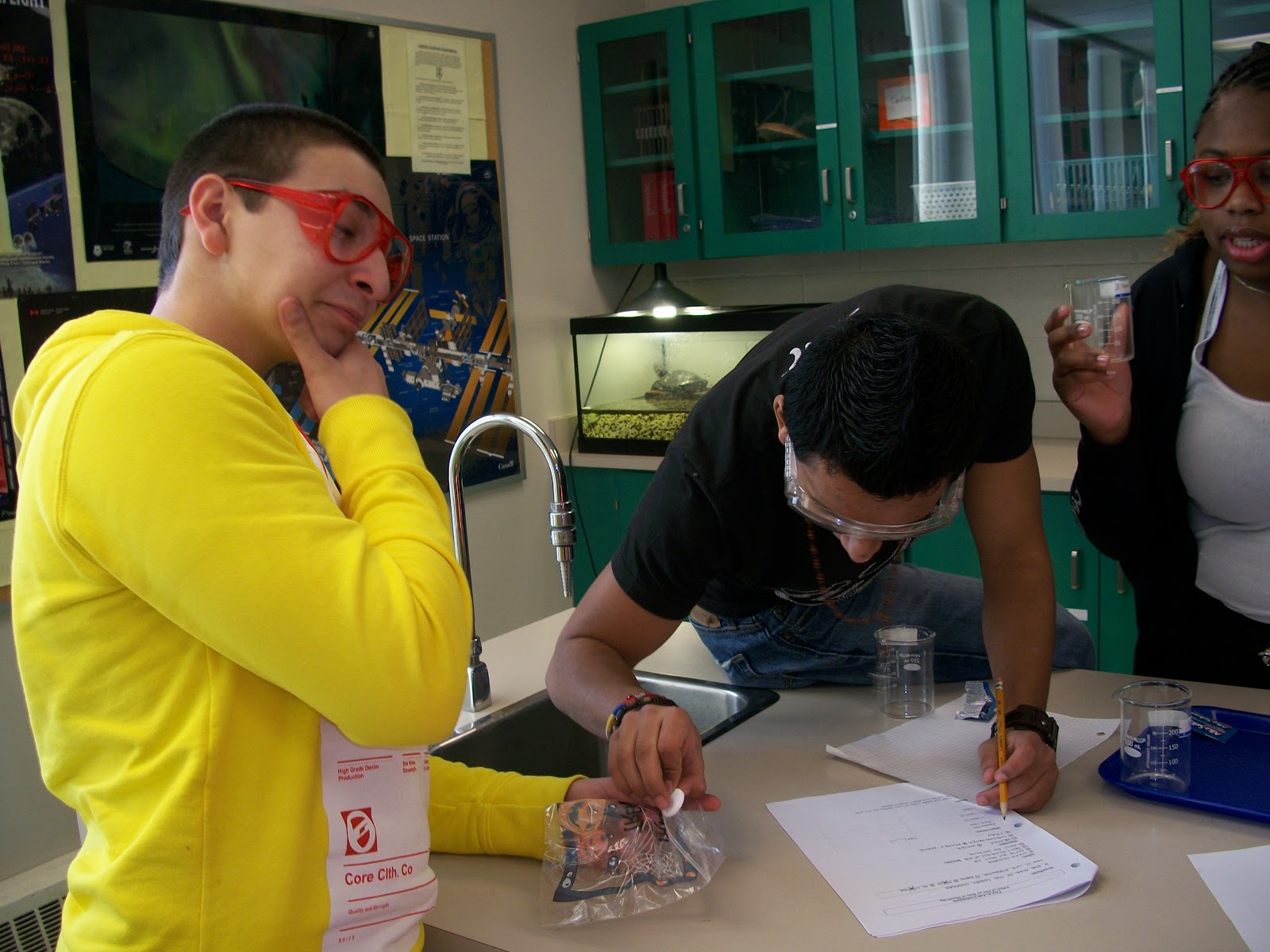
The students worked in pairs for this activity. They had previously been instructed to bring in a fresh fruit or vegetable from home. Since half of the class forgot to bring something in the instructions were to pick a partner where at least one of you had a fruit or vegetable. The produce our class worked with included oranges, carrots, bananas, apples and celery.
Using the first square of the Smarter Science P.E.O.E., Predict, the students made their predictions by making an “If . . .then” statement in this format:
If my apple is sliced up and dried then it will . . .
The students were also expected to draw a picture showing what would happen.
In the second box on the P.E.O.E., Explain, the students had to explain WHY they had made their predictions. This is our first glimpse into their thinking process!
Once the first two boxes of the P.E.O.P were completed the students were instructed to prepare their fruit in whatever way they thought would be most suitable for drying. This caused some initial confusion: Should we peel it? Should we slice it? Should we cut it in half? Because the students are to take ownership of their learning my reply was consistently, “What does your partner think?” Eventually all of the pairs were able to take a risk and make a decision.
In the third box of the P.E.O.E, Observe, the students had to make some initial observations about their prepared samples. Although they were told only to rely on physical properties (those they could detect with their senses) the fact that I had put out our electronic balances that day allowed many of them to infer that recording the initial mass of their samples might be a good idea. Other observations the students made included colour, smell, and texture.
 
When the students returned to class on Monday they rushed to the windows to see what had happened to their samples over the weekend. Some of them wanted to eat their results right away! Pairs with differing types of samples were comparing their changes with no prompting from me. In fact, the students quickly weighed their dried samples and started calculating the amount of water lost without any top-down instruction. The learning just flowed. 
The students recorded their final mass in the third box of their P.E.O.E. as well as any other differences they observed.
In the final box, Explain, the students revisited their initial prediction (box 1) and stated if it was correct or not. They used the evidence they had collected to justify what had happened to their predictions. This is where their critical thinking skills are showcased!
Once again, Smarter Science had allowed the students to OWN their learning! How have you used the P.E.O.E  in your classroom?

How does particle size affect the rate of dissolving? -- An Student Designed Inquiry


 As part of the Culminating Performance Task my grade nine applied science class used the Smarter Science emergent scientist templates (poster set three) to design and conduct an inquiry into the effect of particle size on the rate of dissolving. The solute we dissolved was store bought Alka-Seltzer tablets and the solvent we used was water.
Due to the nature of the learners in my class I assumed that some of them would have no prior knowledge of Alka-Seltzer. So I started the class by showing them the box I had purchased from the drug store, then I opened the box and showed them the packages within and finally I opened the packages and showed them the tablets. Next I showed them Alka-Selters advertisements from Youtube then I dropped one of the tablets into a beaker of water and demonstrated how to time the dissolving process from beginning (initial time) to end (final time). 
While demonstrating the last step I invited the students to pull out their digital devices and use the timers on them to help with the timing. This step allowed the students to become familiar with the timing devices they didn’t even know they had, as well as become aware of the importance of starting and stopping the timer at precisely the right moment in order to record accurate results. Because I had a limited number of tablets available and an even more limited budget with which to purchase more I wanted to ensure that no tablets would be wasted during the actual lab due to failure to record the dissolving time. 
Using the Smarter Science template the students determined that the independent variable for their investigation would be the particle size while the dependent variable would be time (rate). The controlled variables would be:
1.      Size of beaker
2.      Volume of water
3.      Temperature of water
4.      Mass of tablet (predetermined by pharmaceutical company)
5.      Timing device
Each group was given four tablets for their investigations. The particle sizes they would experiment with were:
1.      Whole tablet
2.      Whole tablet broken into halves
3.      Whole tablet broken into quarters
4.      Whole tablet crushed
Each group decided what values to give to their controlled variables and recorded them on the Smarter Science template. Once everything was planned and recorded in an intelligible fashion the students were given their four tablets and got down to some serious science.
This lab worked very well. After performing and recording the investigation the students cleaned up, washed their hands and began analyzing their results. Because most of these students are visual learners I had them use their data to construct a line graph. The results were universal, the crushed tablet dissolved at a much greater rate than any of the other formats. In their written report the students reflected how this knowledge could be used in their daily life. Most have decided to chew their prescribed tablets in the future instead of swallowing them whole. 
 
What labs have your students designed and conducted to investigate the effects of particle size on the rate of dissolving?
Can you recommend any less expensive solutes?

Saturday, April 23, 2011

Using Gizmos to Grow Plants in Locally Developed Science Class – Posting #27

I have tried using the interactive Gizmos available from ExploreLearning.com with my locally developed science classes in the past and have given up in frustration. This week I tried again but I was much more systematic in the way I scaffolded the lesson plan with the end result being real, authentic learning due to a rich, engaging task.
If you are unfamiliar with Gizmos they are online simulations that power scientific inquiry and understanding. In Ontario they are part of the Ministry of Education’s free software package (OSAPAC) which means they are licensed for use in all of our publically funded schools.  There are many other computer simulation programs available but I shall restrict my comments in this blog to the experience our class had with Gizmos.

If you teach science you are probably well aware that many of the students in our classrooms today have spent very little time outside playing – they have never made mud pies, they have never eaten worms, they have never squashed a bug and they have never grown a plant from a seed. In short, they have never experienced the wonder and awe of nature: one of the fundamental concepts essential not just to life but actually identified in our curriculum documents as  “The overall intention is that all graduates of Ontario secondary schools will achieve excellence and a high degree of scientific literacy while maintaining a sense of wonder about the world around them.”
Bearing the sad reality that our students don’t go outside I purchased two packages of different varieties of marigolds at my local hardware store. I photocopied and enlarged both the front and the back of the seed packages and distributed them to my students. We compared the claims made  while learning new vocabulary, ie. marigolds, germination, varieties. Hence, literacy was embedded into the day’s plan. I then showed them how to plant the seeds and each student planted five seeds of each variety into labeled flower pots.  We are not recording any information on these marigold seeds. We check them every day, we discuss our observations, we feel the soil to determine how damp or dry it is, we water and we even turn the plants since we have become aware of phototropism.  (Eventually these pots of marigolds will be sent home for Mother’s Day presents.)
Now that my students had some prior knowledge of how seeds grow I introduced them to the Tomatosphere Project. We used the Smarter Science framework to set up the tomato seeds as a controlled scientific investigation. (See blog posting # 26) This investigation is ongoing.
Every day we check both our marigold and tomato seeds. The students have a good hands-n understanding or the necessity of light, soil and water for seed germination and plant growth. I have not yet introduced them to the concept of fertilizers or compost – although while we are in the greenhouse we check on the vermi worms. It won’t be long now until they will delve into this project a little deeper!
Last week I introduced the class to Gizmos. In preparation for this lesson I pre-registered each student into a class on the ExploreLearning website.  Using a very large font size and bright yellow paper I then made each of them a checklist of:
1.      The name of the website (ExploreLearning.com)
2.      The class code
3.       Username
4.      Password
5.      Name of gizmo
6.      “Launch gizmo” instructions
Using checklists has been identified as an essential employability skill in the Passport to Learning produced by the Conference Board of Canada. I was surprised when I first read this but then I started using checklists with my students and I was amazed that they did not know what to do with them. After embedding checklists into all of my courses as much as possible I am pleased to report that they have become invaluable to both the students and the course delivery.
The Gizmo we used was Growing Plants in which the learner investigates the growth of three common garden plants: tomatoes, beans, and turnips. They can change the amount of light each plant gets, the amount of water added each day, and the type of soil the seed is planted in then observe the effect of each variable on plant height, plant mass, leaf color and leaf size. They determine what conditions produce the tallest and healthiest plants. Height and mass data are displayed on tables and graphs.
I provided them with the lesson material, Student Exploration Sheet, which is published on the website. As the computers were firing up the students answered the two questions that are to be done prior to using the Gizmo. Since these were both opinion questions the students were easily able to answer.  (What do you think plants need to grow? And How do you think soil helps plants? )  Thus, the students were feeling confident about trying the Gizmo. Although the handout provides clearly worded step-by-step instructions some of the students required individual instruction on how to drag the variables to the pots and let the plants grow virtually. The learning curve was extremely short especially when the students realized that there was no wrong answer! They especially liked watching the time fly by on the clock as the plants grew.
Spontaneously there became a class completion of who could grow the tallest plant. This led to lots of cheering and excitement! Everyone was truly engaged! As the students were able to grow their plants taller and taller they exchanged their strategies with each other.( It will come as no surprise to anyone who is familiar with teenage boys to hear that the boys were the ones most motivated by the competition – gotta love that testosterone!)
After declaring a “new world champion of plant growing”, who happened to be the newest student to arrive in my class, we carried on with the student exploration sheet handout which takes the students through a number of controlled tests.
The students were delighted with the entire process declaring that it was so much quicker than waiting for real days to pass so their plants could grow. Besides completing the Gizmo in a very satisfactory manner a lot of excellent thinking, questioning and discussion resulted from this activity. The talk was allowed to flow throughout the process proving, once again, that “Literacy floats on a sea of talk”.

How have you used computer simulations in science inquires?  Send me a tweet at: 
https://twitter.com/#!/EurekaTeacher