Anyone that is involved in education has heard the phrases “21st century education” and “21st century learners” ad infinitum. I don’t know their origin but these words, and more importantly, their meanings slowly crept up on us during the last decade or so.
There are a wide variety of educational, and other, resources which attempt to define and expand on what 21st century education is, or should be. One of the most succinct and comprehensive is Learning for the 21st Century: A Report and Mile Guide for 21st Century Skills , an American publication from the Partnership for 21st Century Skills.
It is outside of my purpose for writing this blog post to argue for definitions around any of the “21st century . . . “terms. If you are unsure of what I am referring to by these terms, this publication is a good overview of what I understand them to be and I am using this as my standard reference.
This summer I started purging all the paper I have accumulated over my ongoing career as an educator. This included filling recycling boxes with dozens of obsolete Ministry, Board and School publications but much more interesting was the walk-through-time that my own personal binders provided. I have taught many courses over the years; suffice it to say that my binder portfolio included 90% of every science course that ever existed in the province of Ontario along with a smattering of courses from completely unrelated subject areas. Being the type of person I am I have always kept beautifully organized binders for each of these courses, and the more times I taught the course the bigger and more numerous the binders became.
So here is what I observed as I purged through my personal binders. At the beginning of my career I used a lot of material that I photocopied from other educators. These included worksheets, projects, assignments, and even tests. The notes for the students were long and detailed, I would write them word by word onto the blackboard and they would sometimes spend entire periods copying them down. In fact, I remember the advice of my mentor, a master-teacher, gave me during my first year teaching when I had a particularly unruly class, “Just keep them copying out notes all period and they won’t have time to cause any trouble.” Now, I am horrified to think that I actually took this advice and relished in its effectiveness!
Over time the work in my binders became more and more my own. Beautifully designed and produced worksheets, text book activities and lab assignments. All the labs were strictly “cookbook” labs with the purpose, safety, materials, procedure all precisely laid out step-by-careful-step. Observation tables and questions were purposely designed to keep the student tightly focused on the task, analysis and discussion questions flowed one from the other and the conclusion was not even always present! Oh, how magnificent these labs were! The preparation for them, although time consuming, was a very exact affair and I would often leave my classroom at night with everything methodically set up for the next day’s lab -- exactly the right number of beakers, and other required equipment laid out next to my carefully measured and prepared solutions of which I would have neither too much nor too little because I knew exactly what would happen during the upcoming lab.
Do not think, dear reader, that I was alone in my anal ways of teaching high school science. My techniques were widely admired and my resources eagerly sought after by colleagues both near and far. I was well respected for never asking the students a question whose answer could not be found on a specific page of our current text book, for integrating literacy and numeracy throughout my curriculum (before it was cool) by the use of teacher guided practice, for running carefully controlled labs whose outcome was never in doubt and which never took longer than the allotted time. Oh yes! I would proudly share my work with anyone that was interested and even gave workshops and made presentations highlighting my wonderful skills. Imagine how flattered I was when publishers took an interest in my magnificence!
But that was then and this in now. As I continued purging my beautiful binders I could see how my teaching had gradually shifted over time. Some of the change was prompted by the powers that be but most of it was in direct response to what worked and what didn’t work, a little thing we like to call “personal reflection” in the teaching field. Lessons that at one time worked like a well oiled machine had to be tweeked as the nature of the learner changed. Rather than stress myself out because the students no longer carefully read the cookbook lab prior to doing it, sketched out the equipment set up and even answered the analysis questions prior to lab day it was much easier to meet them where they were.
At the time I would have described my evolution as “choosing my battles”, after all one has a finite amount of energy, but in retrospect I see it now as being respectful of who the learners were and what worked for them. Gradually I learned to release control yet facilitate the learning occurring. As the years passed, my binders became less dictatorial and more loosey-goosey. Instead of going from day one to day ninety with rigid lesson plans for each and every day they started to reflect the unit we were working on the “big ideas” that we needed to cover on a weekly basis.
My classroom labs changed from being teacher-directed and controlled as well. Over time I started producing lab handouts with less and less detail filled in thereby allowing the students the opportunity to think about what we were doing. I did, however, keep control of what the lab purpose was; but I expected them to do more of the design, observations and analysis themselves.
Luckily for my students, as the 21st century progressed I became familiar with the Smarter Science way of teaching science. This approach is strictly inquiry based with the students not only designing and conducting the labs themselves but also coming up with the purpose, or question. Through brainstorming the students generate a list of questions that they are wondering about. Then, they answer the ones they can through research. Due to having 21st technology in the classroom this research component can be incredibly quick, even as short as five minutes, depending on what the questions are and what strategy the teacher employs. No more booking the library, searching through vertical files, card catalogs and encyclopedias for this generation! Instant access to quality information is the order of the day. The advent of the Internet has truly been a game changer in our quest for knowledge.
After finding the answers they can by research, the students are now left with maybe one or two outstanding questions. Following the Smarter Science framework and 21st century educational philosophy it is time for them to design their lab investigations to answer the questions they are wondering about. This means they have already established a purpose for doing the lab.
Developing hypotheses often flow from a combination of knowledge acquired during their self directed research and ensuing lively classroom discussions. The teachable moment here is the concept that all hypotheses are acceptable, proving them right or wrong is the point of the lab investigation. Literacy is also naturally built in as the teacher demonstrates the correct method of wording a hypothesis. Since each student “owns” their hypothesis they want to learn how to state it correctly, there is nothing rote or boring about it.
In my binders, which I am now thinking about as historical archives, I actually had activities where I gave the students the crux of the hypothesis and they had to phrase it correctly and even worse than that, labs with the hypothesis given! No wonder there wasn’t any critical thinking happening in their poor little minds.
Once the students have determined for themselves why they are doing the lab (purpose) and what they think the outcome will be (hypothesis) all that is left for them to do is the fun stuff –design, perform and analyze the lab. This is where it is essential that the teacher is an expert in their field because they are the ones ultimately responsible for the safety of their students. They must ensure that nothing the students propose could potentially cause any harm. They must also be prepared to advise student on various techniques in a just-in-time teaching manner. This means that we teach the technique when the student needs to use it, not when it is on the next page of the text book.
In my binders I had an entire lesson plan with the objective of learning to use a graduated cylinder! I used overheads to show a picture of a meniscus and distributed worksheets with diagrams of graduated cylinders for the students to read the volume level. No actual graduated cylinder was ever in play! I am so embarrassed! And this was a lesson plan I really liked and shared widely!
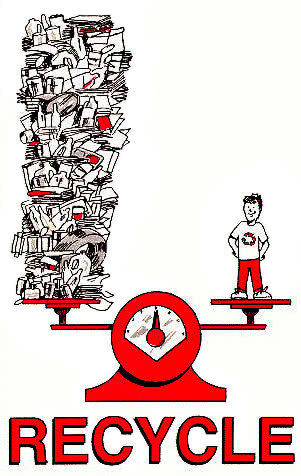
As I conclude this blog post the recycle truck is actually rolling up my street. Three recycle boxes full to over flowing are being heaved over the side of the truck; all my 20th century teacher “gold” is being hauled away. It was fun while it lasted but nothing compares to the excitement of teaching the 21st century way! I wonder what great discoveries my students will make this year, and in the years to come?